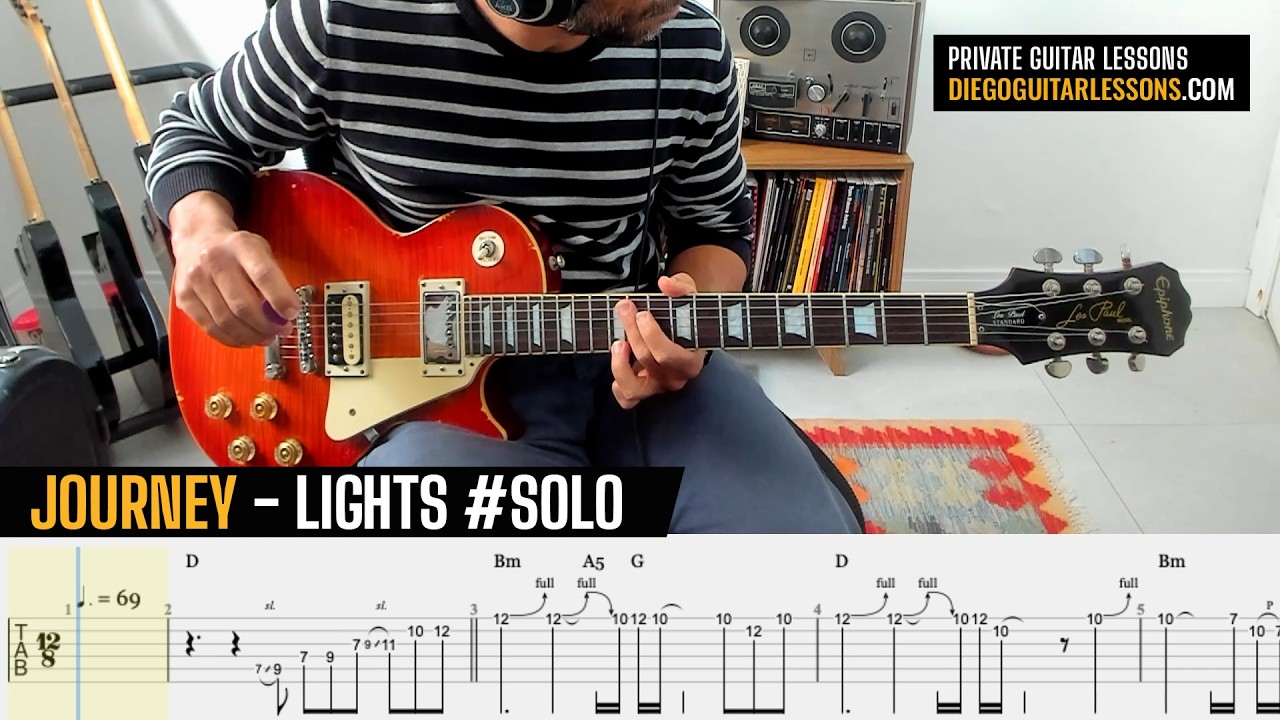
Hey guys, Diego here. This time I transcribed and performed Neal Schon’s guitar solo from Lights by Journey.
What I really like about this solo is the way Schon uses a very familiar rock vocabulary over a progression that is centered around D major. The main progression is D – Bm – A – G, or I – vi – V – IV in D major.
A lot of the solo can be understood through a B minor pentatonic framework. And here is where things get interesting: B minor pentatonic and D major pentatonic contain exactly the same notes.
B minor pentatonic is B – D – E – F# – A, while D major pentatonic is D – E – F# – A – B. The notes are the same. What changes is the tonal center, the harmony underneath and, especially, where you choose to bring your phrases to rest.
One of the most interesting things in this solo is that Schon does not seem to treat every chord as a completely separate harmonic problem. He keeps the B minor pentatonic / D major pentatonic vocabulary moving across the progression and repeatedly brings the melody back toward D and the D major sound.
That creates some beautiful colors because the same note changes function as the chords move underneath it. Over D major, D is the root. Over B minor, D becomes the minor 3rd. Over G, D is the 5th. And over A, D works as the 4th, creating tension against the chord.
You can analyze every one of those relationships separately, and that is important. But for a rock guitarist, there is also a very practical way to simplify the whole thing without ignoring the harmony.
This is something I work on a lot with my private students. First, we look at the progression as a whole in D major. Then we use B minor pentatonic as the rock vocabulary and learn to see the D major triad — D, F# and A inside those same pentatonic shapes, with D becoming an especially useful melodic reference point.
One exercise I really like is very simple: play B minor pentatonic across the neck, then go back through the same shapes and locate D, F# and A. The student needs to actually see the D major triad inside the B minor pentatonic shape.
That is when the scale stops being just a pattern on the fretboard. You still have the bends, slides and familiar rock phrasing of the minor pentatonic, but now you can see the harmony inside the scale and make more deliberate choices about where your phrases are going.
And this is really the goal when I work on this kind of material with a student. I do not want the student to just memorize a scale shape or an arpeggio and play it up and down the neck. I want them to recognize those sounds inside real music and gradually make them part of their own melodic vocabulary when they improvise.
Later in the solo, the harmony briefly moves through Bm7 – C before returning to D, adding another classic rock color to the progression. But the main lesson remains very clear: you can understand a harmonically rich progression and still reduce it to a practical improvising idea.
For me, Lights is a beautiful example of that approach: I – vi – V – IV in D major, B minor pentatonic as the vocabulary, and the D major triad as a reference inside the scale. You understand the complexity first, then turn it into something musical that you can actually use.
WANT TO GO BEYOND THE TAB?
Private Rock Guitar Lessons via Zoom — Diego Fonseca
If you want to understand the phrasing, harmony and melodic ideas behind solos like this, master the techniques that make them work, and learn how to use those ideas in your own playing, we can work on that together in a private 1-on-1 lesson.
✔ Free 30-min trial lesson ✔ 4 × 60-min lessons · $240/month ✔ All timezones — US, Canada & Europe
Fill out the form and Diego will reply within 12 hours.
